

Early Romantic landscape painting
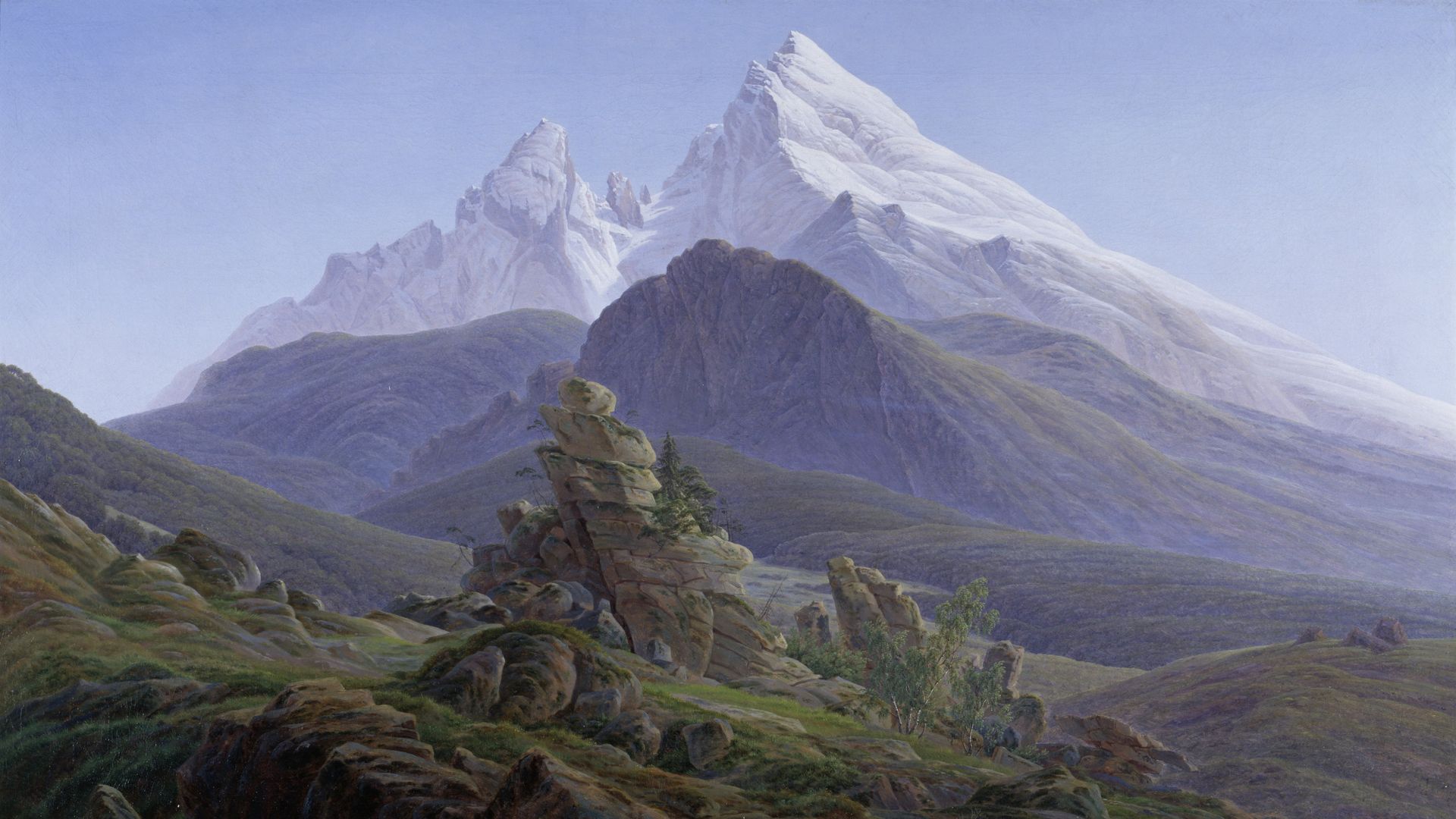
More than 200 years ago, in 1824/25, Caspar David Friedrich painted Mount Watzmann — without ever having visited Berchtesgaden himself. He based the work on a watercolor study created by one of his students. Measuring 136 × 170 centimeters, it remains one of Friedrich’s largest paintings.
To mark the 250th anniversary of Caspar David Friedrich’s birth, two of his most famous works — “The Watzmann” and “Wanderer above the Sea of Fog” — were combined into a single image. The artwork was first exhibited at Hamburger Kunsthalle before later being shown in Berlin.
![[Translate to English:] Caspar David Friedrich - Der Watzmann](https://www.berchtesgaden.de/images/r3dEi09w6Mo/cb:/crop:6981:5362:nowe:0:0/gravity:fp:0.49992837702335:0.5/aHR0cHM6Ly93d3cuYmVyY2h0ZXNnYWRlbi5kZS9maWxlYWRtaW4vQmVyY2h0ZXNnYWRlbi9WaWRlb3MvQ2FzcGFyX0RhdmlkX0ZyaWVkcmljaF8tX1RoZV9XYXR6bWFubl9fMTgyNC0yNV8uanBn "[Translate to English:] Caspar David Friedrich - Der Watzmann")
![[Translate to English:] Caspar David Friedrich - Der Wanderer über dem Nebelmeer](https://www.berchtesgaden.de/images/AMh5Xi1Nssc/cb:/crop:2327:2980:nowe:0:0/gravity:fp:0.49978513107005:0.5/aHR0cHM6Ly93d3cuYmVyY2h0ZXNnYWRlbi5kZS9maWxlYWRtaW4vQmVyY2h0ZXNnYWRlbi9WaWRlb3MvQ2FzcGFyX0RhdmlkX0ZyaWVkcmljaF8tX1dhbmRlcmVyX2Fib3ZlX3RoZV9zZWFfb2ZfZm9nLmpwZw "[Translate to English:] Caspar David Friedrich - Der Wanderer über dem Nebelmeer")
Watzmann in oil on canvas
With his depictions of nature and landscapes, Caspar David Friedrich (1774–1840) is considered one of the pioneers of German Romanticism. In search of inspiring motifs, the painter also turned to Berchtesgaden: in 1824/25, Caspar David Friedrich painted Berchtesgaden’s iconic mountain, the Watzmann, in oil on canvas. Measuring 136 × 170 centimeters, it is one of Friedrich’s largest works.
Although Caspar David Friedrich never visited the Alps himself, he had a deep fascination with mountains and alpine landscapes. His painting of Watzmann was based on a watercolor study created by one of his students in 1821, just one year before the student’s death in Italy. Friedrich was also familiar with Ludwig Richter’s painting of Watzmann, though he rejected its idyllic atmosphere.
Friedrich’s painting shows the mountain from a viewpoint northeast of the massif, with the sun positioned in the southwest. The strict composition of the painting is built around triangles formed by the rising peaks. The two summits and snowfields glowing in the midday sun create the dramatic focal point of the work. Friedrich’s aim was to capture the sublimity and unattainability of the divine, drawing on sketches and studies from various mountain ranges to achieve this vision.
Provenance of the painting “The Watzmann”
After 1832, “The Watzmann” by Caspar David Friedrich belonged to Senator Carl Friedrich Pogge of Greifswald. Through inheritance, the painting later came into the possession of Adolf Gustav Barthold Georg von Pressentin (1814–1879) in Rostock. After his death, it passed to the Jewish art collector Martin Brunn in Berlin, who was forced to sell it to the National Gallery in 1937 under pressure from the National Socialist regime. The proceeds of 25,000 Reichsmarks helped finance his family’s escape to the United States. Adolf Hitler personally approved 10,000 Reichsmarks of the purchase price, also with regard to his second seat of government at Obersalzberg near Berchtesgaden.
Toward the end of World War II, “The Watzmann” was moved to a secure location to protect it from air raids. Beginning in 1968, the painting was exhibited first at the Neue Nationalgalerie and later at Charlottenburg Palace in what was then known as the Gallery of Romanticism.
In 1999, a community of heirs of Martin Brunn in New York was awarded the painting as part of a so-called restitution of Nazi-looted art. In 2002, the Prussian Cultural Heritage Foundation reached an agreement with the heirs: DekaBank, through the mediation of the Cultural Foundation of the German Federal States, purchased the painting legally at a price below market value and made it available to the Berlin National Gallery on permanent loan.