Pushing limits in the mountains
Alexander was born on December 30, 1968, in the Upper Bavarian town of Trostberg as the second of three children. From an early age, he and his siblings were introduced to the world of the mountains by their parents, Thomas and Maria Huber. His father in particular—already well known in mountaineering circles for fast and pioneering ascents in the Western Alps, including the north face of Les Droites—played a defining role in shaping the extreme alpine ambitions of his sons.
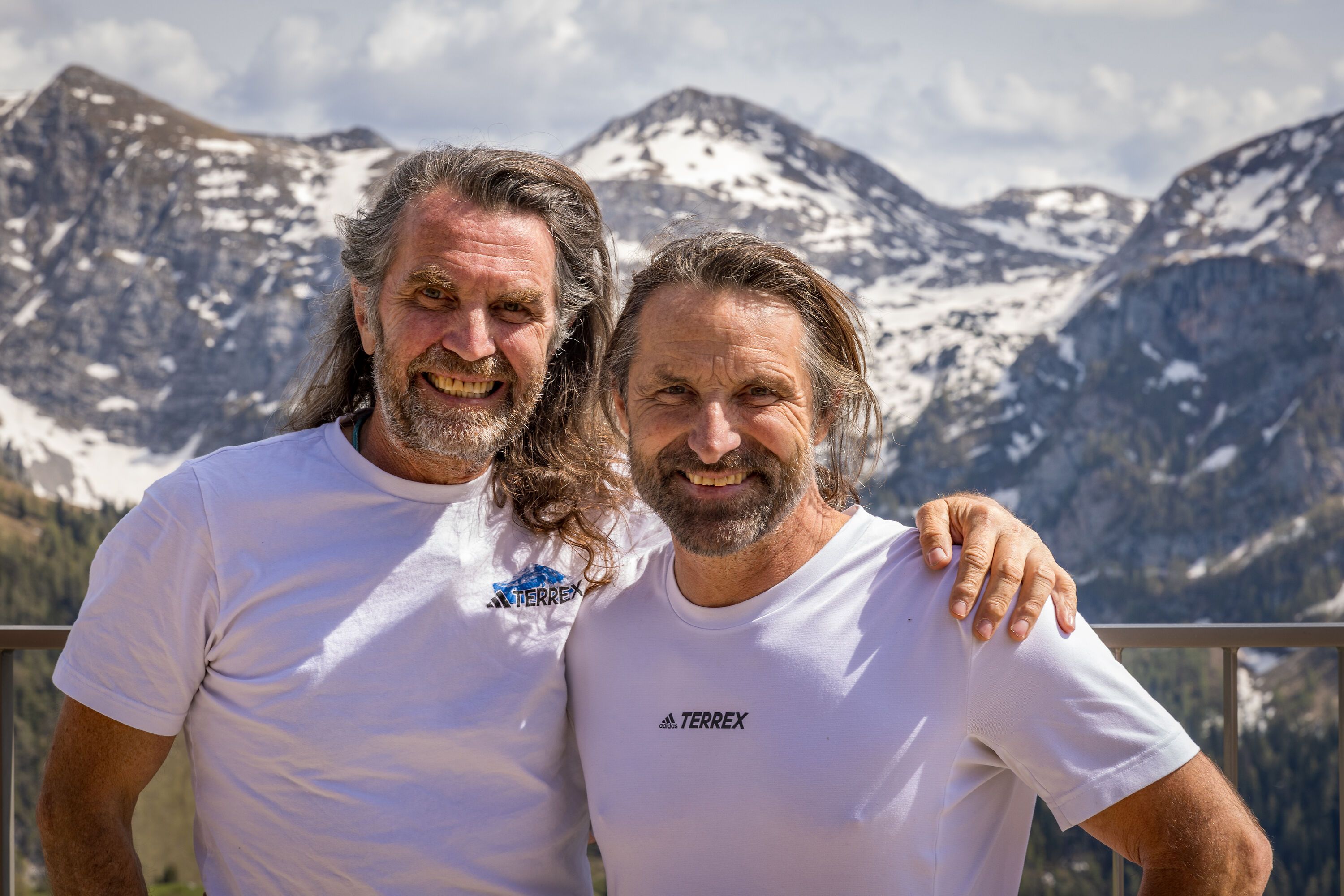
Together with their father, the brothers regularly traveled to the Western Alps and climbed more than 30 four-thousand-meter peaks. By the age of 15, the rope team of the Huberbuam—Bavarian for the Huber Boys—had become the foundation for their future development. Today, Alexander is a certified mountain guide with a degree in physics and ranks among the world’s most accomplished all-around mountaineers.
Alexander first gained international recognition through his achievements in sport climbing. In the mid-1990s, he became the first climber ever to complete routes in the upper eleventh grade with Weiße Rose and Open Air (XI+/9a+). In 1995, he completed the first redpoint ascent of the legendary Salathé route on the 1,000-meter granite walls of El Capitan in Yosemite Valley. With Zodiac (X/5.13d) and five additional first free ascents on El Capitan, he remains one of the leading figures in big wall free climbing.
In 1997, he led an expedition to Pakistan’s Karakoram range and completed the first ascent of the west face of Latok II at 7,108 meters. Together with his team, he became one of the first climbers to transfer big wall climbing techniques to elevations above 6,000 meters and onto the world’s great mountains. One year later, he stood atop Cho Oyu at 8,201 meters, the world’s sixth-highest mountain. Peaks such as Cerro Torre and Fitz Roy in Patagonia also belong to his list of major ascents.
At the end of 2008, the Huber brothers climbed Ulvetanna, considered Antarctica’s most difficult mountain, and established the hardest route on the frozen continent on the west face of Holtanna. Further milestones include the first redpoint ascent of the famous Eternal Flame route (IX+/5.13a) on Nameless Tower at 6,251 meters in August 2009, as well as the first free ascent of the Bayerische Direttissima (X-/5.13b) on Mount Asgard in August 2012.
In winter 2000, Alexander opened a new route on the Great Roof of Cima Ovest di Lavaredo in a solo ascent. One year later, he completed the route—Bellavista (XI-/8c)—free, creating one of the most difficult alpine rock routes ever climbed. He continued pushing the boundaries of alpine multi-pitch climbing in 2006 with the first ascent of Pan Aroma (XI-/8c), also on the Great Roof of Cima Ovest di Lavaredo, which remains one of the world’s most demanding multi-pitch routes today.
Also in the Tre Cime di Lavaredo, Alexander completed a free solo ascent of the Direttissima (VIII+/7a+) on Cima Grande in 2002. Two years later, he pushed the limits even further with Kommunist (X+/8b+), still the only route of its grade climbed free solo. In August 2008, he achieved the first free solo ascent of Grand Capucin, considered one of the Alps’ most difficult peaks.
For Alexander, the Alps remain a true playground for pushing the limits of what’s possible. Whether with the first free ascent of Voie Petite (X/8b) on Grand Capucin or the first ascent of Schweizernase (VII+/A3) on the Matterhorn, his climbs rank among the finest and most demanding ever completed on alpine walls around the world.
Alexander and Thomas are true all-rounders, and it is precisely these versatile skills that place them among the world’s fastest climbing teams. Today, the Huberbuam hold the speed record for the fastest ascent of a big wall on El Capitan with Zodiac in 1:51:34—just as they held the speed record on what is arguably the world’s most famous rock route, The Nose, with a time of 2:45:45 in 2007 and 2008. Their attempts to break the speed record on The Nose became the basis for the movie Am Limit.