Features of Stiftskirche Berchtesgaden
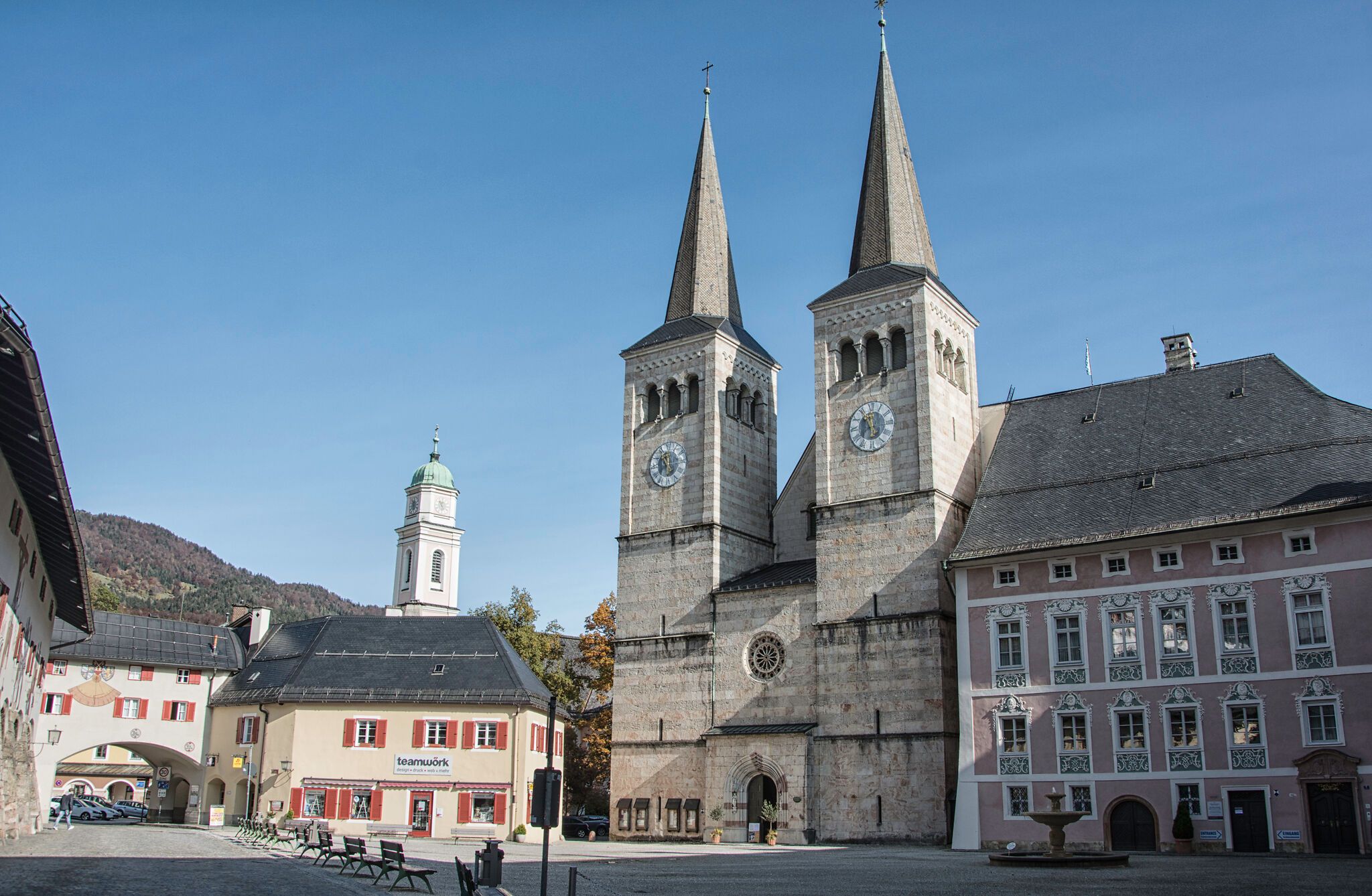
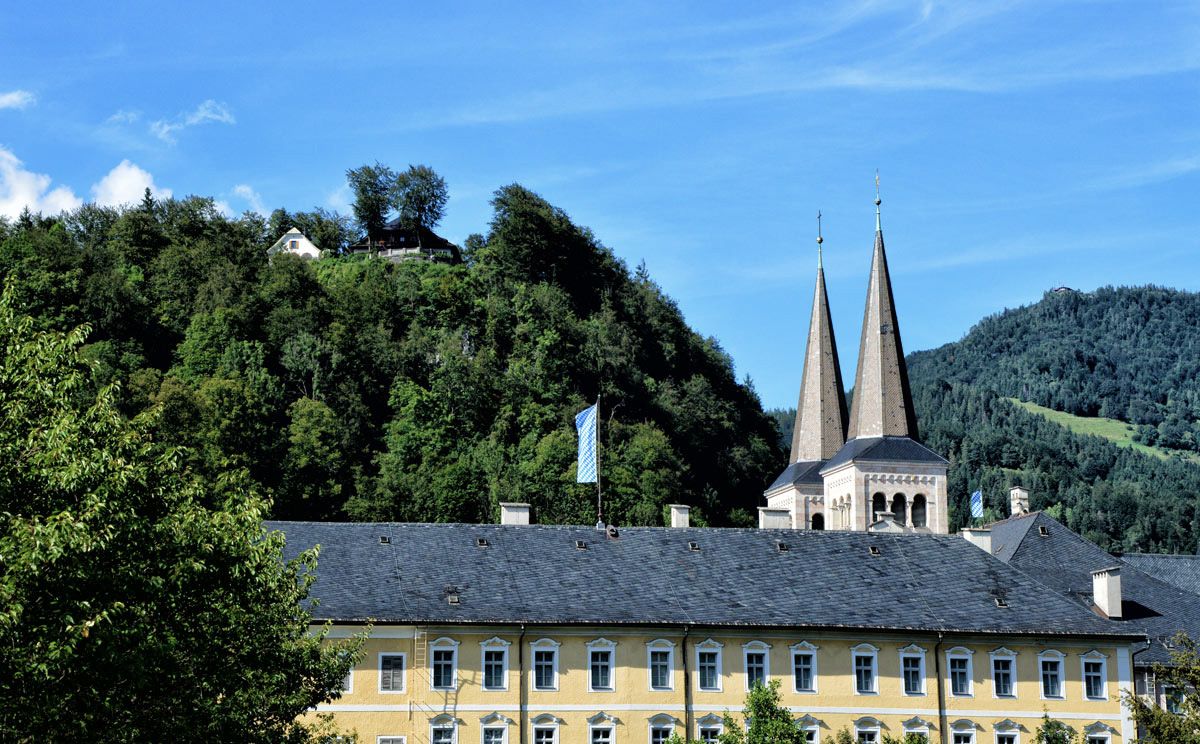
From Schlossplatz, you enter the vestibule on the western side and come face to face with the Late Romanesque main portal. This imposing stepped portal makes the relatively small doorway in the façade appear larger. The portal jambs widen outward in a series of steps, creating an impressive optical effect that almost naturally draws you into the church. The alternating red Adnet marble and yellowish-white Untersberg marble can also be found on several important portals in Salzburg. The two portal lions were also carved from Untersberg marble; one of them is now located in the northeastern part of the cloister.
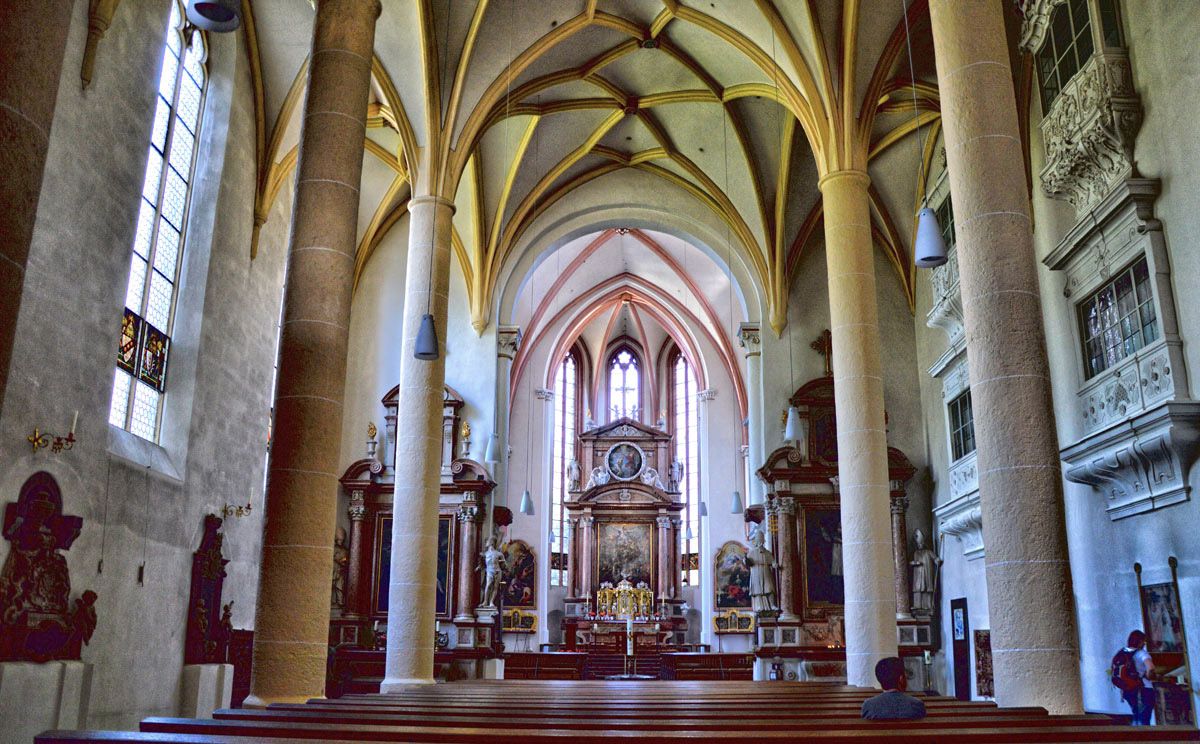
You now enter the darker nave, which forms a striking contrast to the higher, light-filled choir. The irregular net-ribbed vault, created for reasons related to the chronology or technical requirements of the construction, forms the ceiling of the nave and gives the space its distinctive character. The choir of Stiftskirche was not raised because of a crypt underneath. Instead, the canons wanted to emphasize the special significance of this part of the church, almost like a stage.
The choir stalls are a masterpiece of Gothic craftsmanship. Particularly striking are the end panels and dividing panels from the first half of the 14th century, decorated with vines and figures of animals. They depict a lion, pelican, unicorn, and deer. Their symbolism reaches back to the Romanesque period, with each conveying a message of the Christian faith. The lion represents Christ the King, while the pelican symbolizes Jesus’ self-sacrificing death on the cross for the world. The mythical unicorn represents goodness and purification from evil. The deer symbolizes redemption through Christ, into whom we are baptized.
Much has changed...
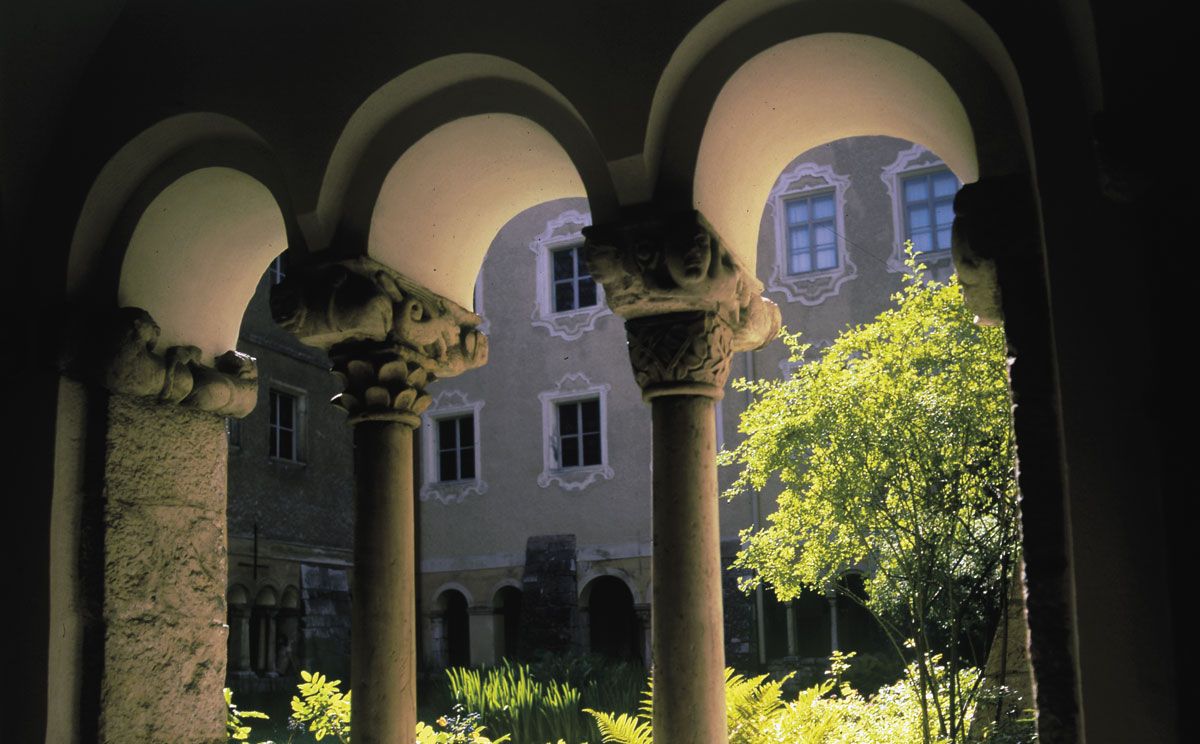
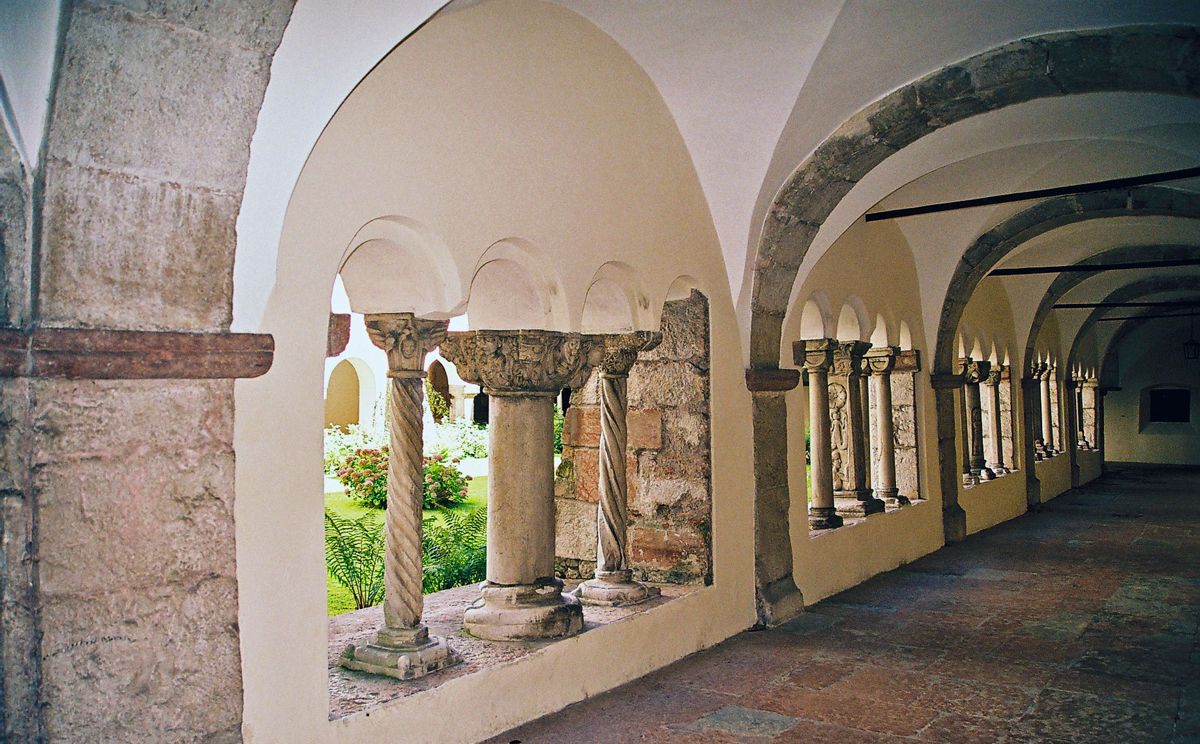
Today, you no longer enter the Late Romanesque cloister adjoining the south side of the former monastery church from inside the church, but from Schlossplatz. The cloister formed the heart of the monastery complex. The various communal rooms and living areas of the monastery, as well as the church itself, were connected to it and accessible from it. Canons and people closely associated with the monastery were buried here, as numerous gravestones still bear witness today.
The cloister enclosed the cloister garden, but it was also a place where the canons spent time as part of their daily monastic routine—with periods of silence and meditation, times for conversation, and the activities of everyday life. It was therefore also the monastery’s center of communication.
The architectural sculpture created when the cloister was built did not strive for realistic representations or proportions. Instead, its purpose was to convey Christian symbolism. Dramatic scenes, demonic faces, and grotesques were intended to capture the eye. The strong contrast between symbols of good and evil was deliberate and carefully designed.
Romanesque sculpture is characterized by its emphasis on powerful expression and its purpose of conveying the Christian faith. Romanesque interlace ornament decorates the columns and pillars. Here, too, you encounter the symbolic world of the Middle Ages.
Dedicated to two saints
Stiftskirche is dedicated to two saints: St. Peter and St. John the Baptist. Both are closely connected to the life of Jesus. Jesus was baptized by John, who came before him, while Peter was called to follow Jesus. Peter was given the challenging task of leading the Church founded by Christ with wisdom and steadfastness.
The two saints undoubtedly also held special significance for the Augustinian Canons who built Stiftskirche. You’ll encounter the church’s two patron saints in several places—sometimes so subtly that you’ll need to look closely. St. John the Baptist and St. Peter are depicted on the high altar, the side altars, and a stele-shaped wall shrine.
The Holy Door in Berchtesgaden
On December 8, 2015, Pope Francis opened the Holy Door of St. Peter’s Basilica in the Vatican, marking the beginning of the Extraordinary Jubilee of Mercy. But the faithful did not have to travel to the Vatican to pass through a Holy Door. On December 13, 2015, the third Sunday of Advent, the “Door of Mercy” at the north portal of Stiftskirche Berchtesgaden was opened during a festive church service. Until November 20, 2016, it stood as a special symbol of mercy.
Spiritual reflection
"And I tell you that you are Peter, and on this rock I will build my church, and the gates of Hades will not overcome it." – Matthew 16:18
Jesus entrusted Peter with the task of carrying on his Church. Jesus trusted Peter even though Peter had already shown his weaknesses several times. He believed Peter could remain steadfast despite knowing those weaknesses. And Peter did not disappoint him.
What do we believe others are capable of? Who do we encourage and give a sense of security that helps them successfully face challenges?
Gasthof Neuhaus: Church and inn
Gasthof Neuhaus was built in 1576 by Prince-Provost Jakob II as a court tavern where guests could stay and dine. It served this purpose until 1797.
Until the mid-17th century, the court tavern served wine exclusively, as beer could not yet be stored for extended periods. Neuhaus accommodated not only the Prince-Provost’s guests; a wide variety of craft guilds also held their meetings here.
The inn also played an important role in Berchtesgaden’s political life. Mayoral elections, for example, were held here.
Neuhaus belonged to the monastery of the Augustinian Canons for more than 200 years before passing into private ownership in 1797. Another change followed in 1815: after Anton Wurm, then owner of Hofbrauhaus Berchtesgaden, purchased the inn, he also began serving his beer there.
From the beginning, the restaurant was operated exclusively by “Bestandwirte,” or tenant innkeepers. Remarkably, the innkeepers often died young, after which their widows married a new “Bestandwirt.” As a result, tenants changed at regular intervals until Neuhaus closed for the first time in 1971 for extensive renovations. In the years that followed, this traditional inn on the market square opened only occasionally.
Since Gasthaus Neuhaus reopened in 2013, visitors and locals alike have once again enjoyed stopping here. Its historic dining room with its distinctive vaulted ceiling and its beer garden—which, incidentally, was filled in during the 19th century using rubble from the old towers of Stiftskirche—make the inn a popular gathering place. In summer, you can spend relaxing hours in the shade of its distinctive chestnut trees.