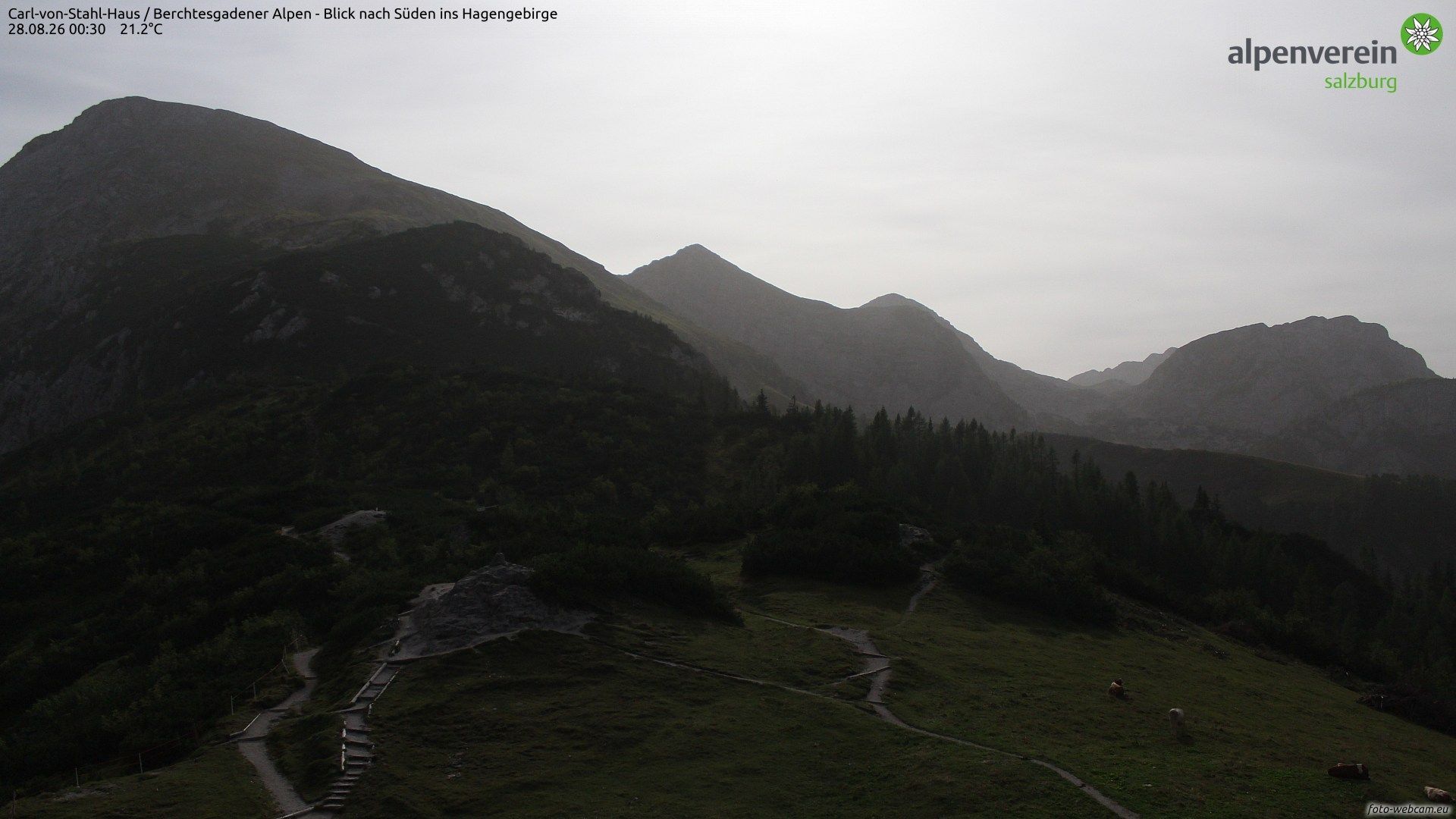
A Portrait of a Mountain Hut: The Carl-von-Stahl House
by Ann-Kathrin Helbig
The Carl-von-Stahl House is located at 1,736 meters above sea level. It owes its name to Carl Stahl. During World War I, hunting took place at the Torrener Joch—and it was organized by none other than the Krupp dynasty. Representatives of the dynasty were open-minded toward Alpine tourists and eventually exchanged land at the Torrener Joch for the Jochalm with the Alpine Club; this exchange was very advantageous for the construction of the mountain hut, as the Joch was in a much more favorable location. The Salzburg Section had overextended itself with other hut projects and no longer had the funds for a new hut. Then an emigrant from Austria, Carl Stahl, who had made his fortune as an industrialist in the textile industry in America, stepped in. He donated the funds necessary for the hut’s construction to the Salzburg Section. He did not live to see the inauguration of his hut on July 22, 1923, but his widow attended. But it’s not just the hut’s past that’s interesting—its present is, too! For 40 years, Helmut Pfitzer, known as “Heli,” was the hut manager at the Stahlhaus. Since 2012, Peter Pruckner has been the tenant of the hut.
The experienced mountaineer and lodge manager is not only the tenant of the lodge but also ensures the culinary well-being of his guests. The excellent cuisine offers freshly prepared home-style meals and traditional Alpine dishes. When Peter Pruckner was still a lodge manager in Upper Austria, his Kaiserschmarren was named the best in the region! I myself always love coming to the Stahlhaus, especially because of the food and the friendly, warm-hearted team!
The Stahlhaus can be reached via trails of varying difficulty levels, from easy to difficult. The easiest way to reach the hut is via the Jenner mountain station in just over an hour. However, you can also hike up to the Stahlhaus via the Jenner midway station (3 hours), the Hinterbrand parking lot (3 hours), or via the Hochbahn – Königsbachalm (4 hours). These trails are marked with a blue dot and are well-maintained. The ascent becomes more difficult if you go via Golling (4 hours) or hike the Kleine Reib’n in reverse (approx. 8 hours). So, if you hike from the Hochbahn – Königsbachalm or the Hinterbrand parking lot to the Priesbergalm, continuing up via the Stiergraben to the Seeleinsee, and then ascending to the Schneibstein—after a final one-and-a-half-hour descent from the Schneibstein, you’ll arrive at the Stahlhaus and will definitely have earned a break. For the truly hardy, the route to the Stahlhaus via the Hoher Göll and the Hohe Brett is, of course, a great option (6 hours from the Purtschellerhaus). The Stahlhaus offers not only charming ascents but also a variety of connecting routes. For example, you can descend via the Schneibstein to Seeleinsee and from there ascend to the Hochgeschirr, and—depending on your preference and schedule—continue on to the Gotzenalm or the Wasseralm (approx. 7 hours). Summit ascents are also possible. The easiest to reach is the Stahlhaus’s local peak, the Pfaffenkegel (1,850 m). It takes about 20 minutes to reach this mountain, which lies behind the lodge. The final 10 meters to the summit are secured with a wire rope. This peak is often passed on the way up to or down from the Hohe Brett. The ascent to the Schneibstein is only slightly more difficult and is also a popular destination for day visitors. In about an hour and a half, you’ll reach its summit plateau. There, you can enjoy a wonderful view of the Steinernes Meer and the wild Hagen Mountains, and with a little luck, you might even spot some ibex up close.
There are appealing routes not only for hikers—climbers will also find plenty to enjoy! On the south face of the Hoher Brett, for example, the Stahlhausrallye has a difficulty rating of VII+, and the Stahlhart is rated VII-. The southwest face of the Hoher Brett features the “Weg der alten Männer” (Path of the Old Men). First ascended by Rudi Wienerroither and his companion, with a difficulty rating of V+ VI-. There are also easier climbing routes starting from the Jägerkreuz/Pfaffenkegel. For example, the “Jägerlatein” and the “Silberpfeil,” both with a difficulty rating of V+.
After all that physical exertion, the Stahlhaus is also a great place to spend the night. The hut has 44 beds and 58 dorm beds, as well as modern restroom facilities. Yet despite the high number of overnight guests, you can still find a quiet spot at the Stahlhaus if you stay during the week. The double rooms are especially nice if you’d like to stay with your partner. After a hearty breakfast, you can then set off again—either to another hut or by booking another night’s stay and spending the day climbing one of the peaks.
The Stahlhaus isn’t just popular in the summer. It’s actually one of the few mountain huts in the Eastern Alps that’s open ALL YEAR ROUND. It’s closed only on December 24. New Year’s Eve at the Stahlhaus is also popular. Rumor has it that you should book very early if you want to ring in the New Year there.
Winter also offers plenty of outdoor activities around the Stahlhaus. The “Kleine Reib’n” is also popular with ski tourers in the winter. Ski touring is becoming increasingly popular. Quite simply because it offers the opportunity to reach high-mountain regions in winter that were previously accessible only in midsummer. The Jenner ski area is also located in the immediate vicinity. Groomed slopes are often used as access routes in winter. Snowshoeing is also becoming increasingly popular. The best way to reach the Stahlhaus on snowshoes is to ascend via the Hochbahn and the Königsbachalm. This route doesn’t require crossing any groomed slopes. An overnight stay in winter is especially worthwhile for those who want to tackle the so-called Große Reib’n. The Große Reib’n is one of the most challenging ski tours in the Eastern Alps. It covers a distance of nearly 50 kilometers and features descent sections with gradients of up to 40 percent.
Another highlight in both summer and winter is the morning sunrise at the Stahlhaus. It’s hard to put into words just how beautifully the sky and the mountains are colored. For that reason alone, spending the night at the Stahlhaus is worth it. I myself stayed at the Stahlhaus for the first time in March 2014. Alone, I made my way up to the Stahlhaus on snowshoes via the Hochbahn and the Königsbachalm. I didn’t know anyone at the Stahlhaus—not the owner, his team, nor any of the guests. Once I reached the top, I had a bite to eat, and both the staff and—above all—the owner, Peter Pruckner, immediately noticed that a female snowshoer had arrived alone and was spending the night up here. He quickly approached me in a friendly manner, and we had a nice chat. Susi, the hut dog—who’s now well-known among the locals—also greeted me warmly and patiently let me pet her. In the evening, when the half-board meal (soup, main course, and dessert) was served, I struck up a conversation with two other guests. We laughed a lot and even played some music. Quaint and cozy! Quiet hours began at 10 p.m., which all the guests were happy to observe after their strenuous climbs. I set my alarm very early so I wouldn’t miss the sunrise. I wanted to watch it from the hut’s terrace and capture it with my camera. But what my eyes saw there—not even the most beautiful photo could do it justice! After breakfast, I stayed until noon, just to enjoy the beautiful view and the wonderfully warming winter sun. It was a unique atmosphere that I, as a former city dweller who had experienced winters without a single flake of snow, enjoyed to the fullest.